
Primary Capability
Rigid-Flex PCB
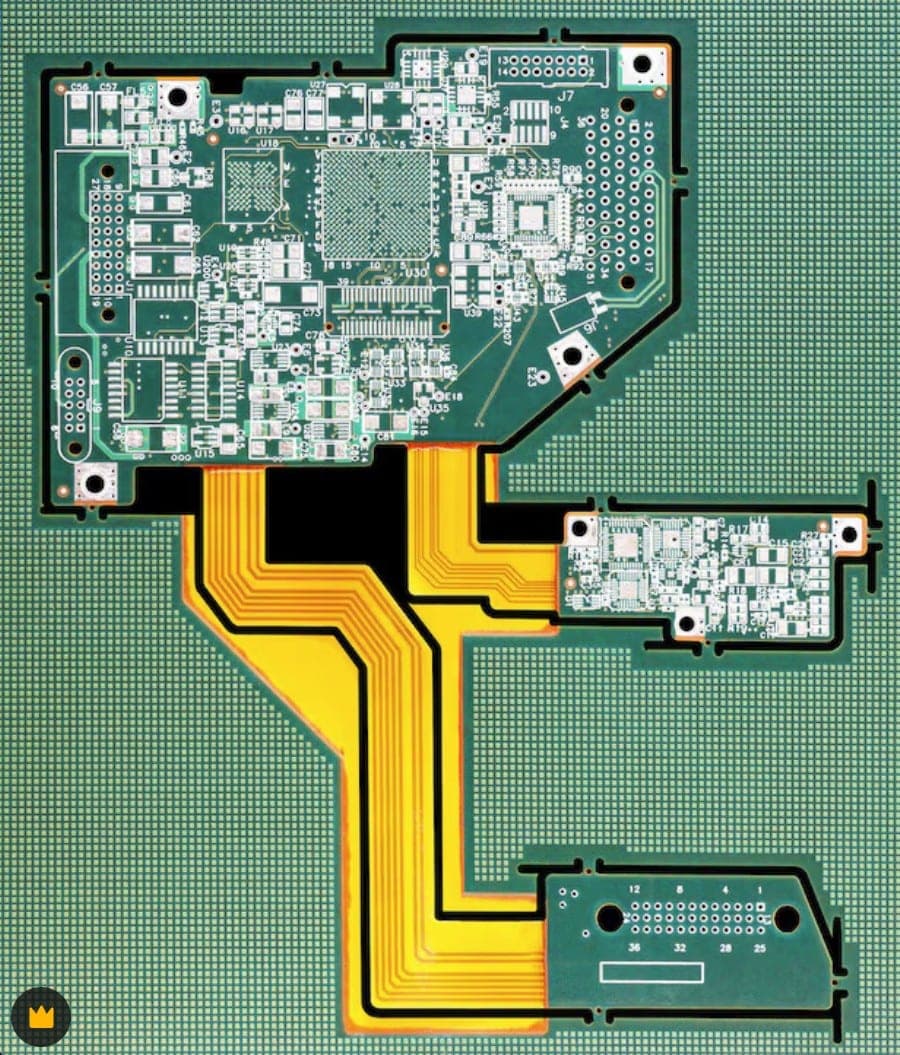
Rigid board sections connected by flexible circuit layers, combined into a single assembly instead of separate boards joined by cables.
Overview
Rigid board sections connected by flexible circuit layers, combined into a single assembly instead of separate boards joined by cables.
Why it matters
Where a product needs to fold, hinge, or fit into a non-flat enclosure, rigid-flex removes the connectors and wiring harnesses that would otherwise be extra failure points.
Typical Applications
- Foldable and hinged devices
- Aerospace and defense packaging
- Wearables with articulated sections
- Compact assemblies with tight 3D packaging constraints
Manufacturing Considerations
- Bend radius and flex-cycle life need to be planned into the design, not added afterward
- Material selection differs between rigid and flex zones and affects lamination
- Assembly and handling require different fixturing than a flat rigid board
Technical Characteristics
- Max layer count
- 28 layers
- Min trace / space
- 3 / 3 mil
- Min hole size
- 0.1 mm
- Standard materials
- FR4 High TG + PIAP8525RAP8515RLF0100LF0130LF0200
- Surface finish options
- ENIGImmersion TinOSPHASL-LFImmersion SilverGold FingerElectroplated Hard GoldSelective OSPENEPIG
- Typical turnaround
- 10–15 working days
Exact specifications are confirmed per order — send a spec through Request a Quote for a firm answer. Company-wide process limits are published on the Capabilities page.
Ready to spec a Rigid-Flex PCB?
Board type, quantity, layers, material — engineering reviews the full picture.